
What Is Content Marketing? Everything a Beginner Needs to Know
Imagine buying from a brand not because they hit you with a loud, disruptive advertisement, but because they genuinely helped you solve a problem first. That is the core philosophy behind inbound marketing. If you are a recent graduate or a career switcher trying to understand the digital landscape, learning “what is content marketing?” is your absolute first step toward building a successful career. At its heart, this strategy focuses on building relationships rather than forcing transactions.
Key Takeaways
- Education Over Promotion: Successful content builds trust by solving user problems up front rather than pitching a product immediately.
- Structured Customer Journeys: Marketers map content to specific funnel stages (TOFU, MOFU, BOFU) to guide prospects from awareness to a purchase decision.
- Empathy-Driven Results: Organic sales happen naturally when a business consistently treats the consumer as the hero of its story.
- Accessible Career Path: The field rewards transferable skills such as writing clarity, empathy, and basic data analysis over formal marketing degrees.
Content Marketing vs. Traditional Advertising: What’s the Difference?
Content marketing is a strategic business approach focused on creating and distributing valuable, relevant, and consistent material to attract and retain a clearly defined audience. Traditional advertising, by contrast, relies on outbound methods that interrupt the consumer to pitch a product or service. When you watch a television commercial or see a pop-up ad while reading the news, a brand is paying to force its message into your view.
Think of traditional advertising like a pushy car salesman who interrupts your weekend to demand your attention. Content marketing acts more like a trusted local mechanic who creates free YouTube videos showing people how to check their own oil or diagnose a strange engine noise. The mechanic doesn’t demand that you buy anything today. However, when your car suffers a major breakdown, you will naturally take it to the person who has already proven their expertise and helped you for free. For a new website aiming to earn authority with crawlers, mastering this pull strategy is far more effective than paying for interrupted attention.
The Core Pillar: What Exactly Makes Content “Valuable”?
Valuable content is digital material that solves a specific human problem, answers an urgent question, or guides a reader through a complex task without expecting an immediate financial return. In the digital marketing industry, the word “content” gets thrown around constantly, but material only holds marketing value if it serves the audience’s explicit search intent.
It Must Be Relevant and Informative
Relevant and informative content matches the exact real-world queries your audience types into a search engine. To establish a strong footprint in a search engine index, you cannot simply write about what your business offers; you must write about what your future customers experience. If a user is searching for how to balance a budget, a valuable article breaks down the exact steps using everyday math, completely independent of any software product.
It Focuses on Education Over Promotion
Educational content prioritises teaching a skill or clarifying a concept over making an immediate sales pitch. Beginners often make the mistake of turning every blog paragraph into a product advertisement. True value means letting the information stand on its own feet. When you focus entirely on teaching, you reduce the natural resistance consumers feel toward corporate messaging.
It Builds Long-Term Trust
Long-term trust is the cumulative psychological bond formed between an audience and a publisher when information remains consistently accurate, honest, and helpful over time. You cannot build a brand reputation with a single high-quality post. When a consumer returns to your blog three separate times and finds genuine utility each time, their friction toward doing business with you drops significantly.
Breaking Down the Content Marketing Funnel Stages
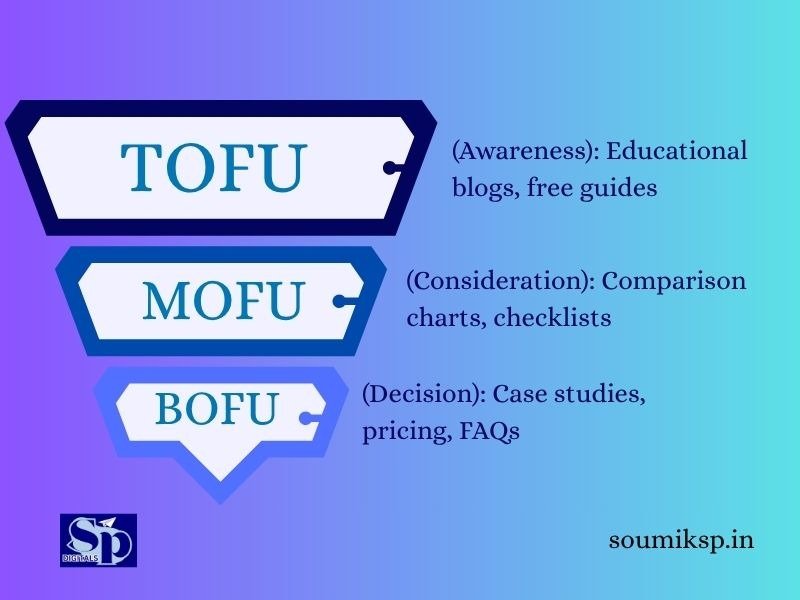
The content marketing funnel is a conceptual framework that maps out the psychological journey a stranger takes from the moment they first discover a brand to the moment they become a paying customer. To convert traffic into revenue, marketers organise campaigns into three distinct structural phases: Top of Funnel, Middle of Funnel, and Bottom of Funnel.
Top of Funnel (TOFU): Attracting Awareness
Top of Funnel content consists of broad, educational resources designed to answer basic informational questions and attract the maximum number of new visitors. At this stage, the consumer is frequently trying to identify or name their underlying problem. They are not looking for a vendor or a product yet. Examples of TOFU content include introductory guides, basic explainers, and short instructional social media videos.
Middle of Funnel (MOFU): Building Consideration and Trust
Middle of Funnel content comprises detailed, mid-level resources that help people evaluate different methods and strategies for solving their newly identified problem. The reader now knows what their issue is, and they are actively comparing their options. To support them, marketers create detailed how-to manuals, downloadable templates, and interactive spreadsheets that help users organise their approach.
Bottom of Funnel (BOFU): Driving the Final Decision
Bottom of Funnel content is highly specific, conversion-focused material designed to reassure a prospective buyer that a specific product or service is the absolute best solution for their needs. The audience is highly informed at this point and is ready to make a financial commitment. BOFU assets include transparent pricing breakdowns, direct product comparisons, and detailed case studies showing real customer results.
Written vs. Visual Media: Which Should You Start With?
Written and visual media are the physical communication formats marketers use to package, format, and present their educational insights to the public. For an entry-level professional, deciding where to deploy your creative energy depends heavily on where your target audience spends their time and how they prefer to digest information.
| Medium Format | Common Asset Types | Best Used For |
| Written Content | Blog articles, eBooks, email newsletters, case studies | In-depth educational guides, earning organic search traffic, and explaining complex frameworks. |
| Visual/Audio Content | Infographics, short-form video, podcasts, slide decks | Explaining step-by-step processes quickly, social media distribution, and driving emotional connection. |
For a brand-new website, starting with a foundational layer of written blog content is generally the most effective approach. Written text allows search engines to easily crawl and categorise your site’s topical relevance, which forms the baseline of your visibility before expanding into resource-heavy video production.
Beyond Plain Text: The Crucial Role of Storytelling
Storytelling in marketing is the practice of using narrative arcs, character journeys, and emotional setups to make educational information relatable, memorable, and impactful. Human beings do not naturally form emotional connections with dry data points or technical specifications. We remember narratives.
When structuring marketing content, you should position your customer as the “hero” of the story, and your business or insights as the “guide” who hands them the tool to win. Instead of stating that a software tool saves four hours a week, tell the story of a stressed-for-time small business owner who finally made it home for family dinner because they optimised their workflow. This structural framing changes how a consumer processes the information, transforming a basic tutorial into a memorable brand experience.
How Educational Content Drives Organic Sales Without Being Pushy
Educational content drives business revenue by establishing top-of-mind awareness and authority, ensuring that consumers naturally choose your brand when they decide to purchase. Traditional methods demand that a customer buy now, using artificial urgency or aggressive pitches. Content marketing takes a completely different path.
By consistently answering user questions, you occupy digital real estate on search engines. This visibility brings sustainable traffic to your web property. When a consumer feels ready to transition from a learner to a buyer, they will completely bypass unfamiliar competitors to purchase from the brand that has spent months freely giving them valuable answers.
Real-World Examples of Content Marketing for Beginners
Real-world content marketing examples demonstrate how businesses across different industries successfully trade upfront education for long-term customer loyalty. Seeing these frameworks in action makes the abstract concepts highly concrete.
- The B2C Example (Fitness Mobile App): Instead of running constant banner ads telling people to download their $10-a-month fitness application, the company builds an expansive, free library of nutrition guides, macro calculators, and home workout videos. Users find the recipes via search engines, share them with friends, and use the free tools daily. When those users eventually decide they need a structured mobile tracking system, they subscribe to the app because they are already familiar with the ecosystem.
- The B2B Example (Invoicing Software): A company that sells financial software to independent workers builds a comprehensive tax-season survival hub. They offer free downloadable spreadsheet templates, write comprehensive guides explaining legal deductions, and interview CPAs. Freelancers bookmark the hub because it saves them hundreds of dollars in professional consulting fees. When their freelancing business expands to the point where manual spreadsheets are too slow, they upgrade to the company’s paid automated platform.
Your Next Steps: How to Start Practising Today
Content marketing is a sustainable, compounding business strategy that trades short-term sales pitches for long-term audience trust. For anyone starting a new blog or transitioning into a marketing career, your path forward is rooted in consistency and empathy.
If you are ready to put this guide into practice, your immediate next step is to choose one specific problem your target audience faces this week. Write a clear, comprehensive, single-page solution that completely covers that topic without adding fluff or unnecessary jargon. Focus entirely on helping your reader win, and the search engine results will follow.
FAQs
Ans: The main goal of content marketing is to build a loyal, engaged audience by consistently delivering high-quality, educational material, which ultimately guides those individuals to take a profitable customer action over time.
Ans: Because organic growth relies on establishing authority and earning natural backlinks, it typically takes six to nine months of consistent publishing to see compounding growth in search engine rankings and business leads.
Ans: Yes, content marketing is an exceptional career path for switchers because it directly rewards transferable human skills such as empathy, strong communication, organised project management, and creative storytelling over formal industry credentials.
Ans: To secure an entry-level position in this field, you must demonstrate strong writing clarity, a foundational understanding of search intent, basic digital research capabilities, and a genuine willingness to learn the fundamentals of modern SEO.