

What Is SEO and How Does It Actually Work?
Every day, 8.5 billion searches are made on Google. That’s 8.5 billion moments where someone types a question and expects the best answer — fast. The websites that consistently show up at the top of those results don’t get there by luck. They get there because of SEO.
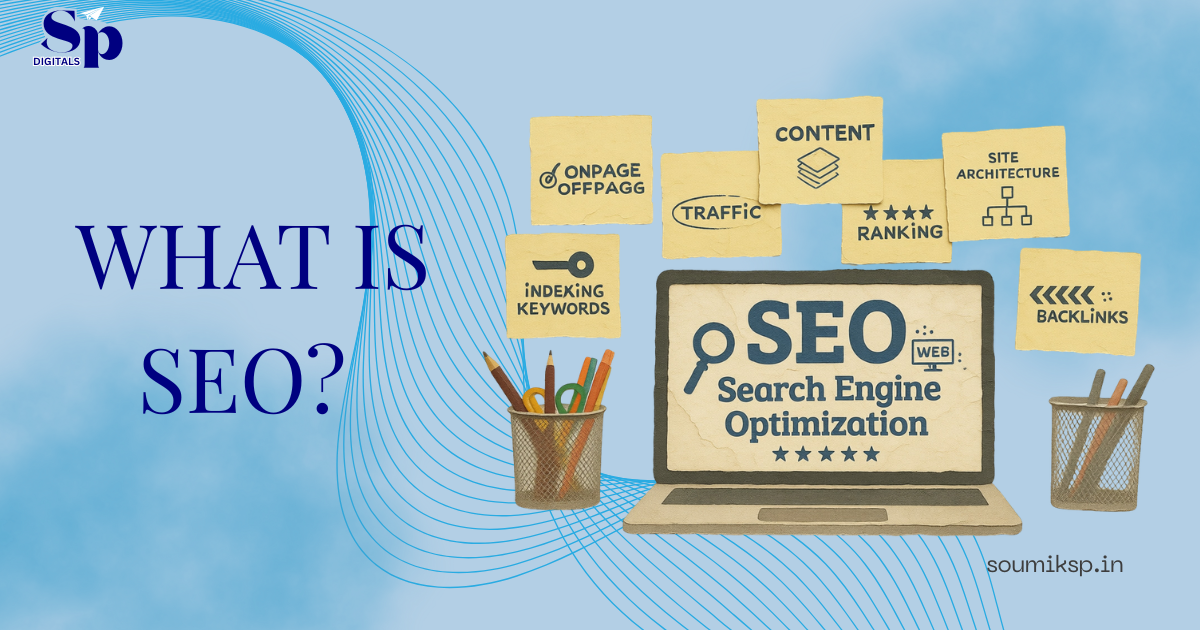
So, what is SEO? In the simplest terms, Search Engine Optimisation is the process of making your website visible to search engines so that it ranks higher in organic, unpaid results. More visibility means more traffic, more trust, and ultimately more growth.
This guide walks you through what SEO means, how it works behind the scenes, the three pillars every digital marketer must understand, the types of SEO techniques (including the ones you should avoid), and what careers in SEO actually look like in India.
What Is SEO, Really?
SEO stands for Search Engine Optimisation. The most important part of Digital Marketing is a website. According to Mailchimp, it is the practice of optimising your website to rank higher on search engine results pages (SERPs), so you receive more traffic and appear on the first page of Google for terms your target audience is already searching.
Think of Google as the world’s largest library. When someone searches “best running shoes for flat feet,” Google’s job is to instantly retrieve the most relevant, trustworthy, and useful page for that specific query. SEO is how you make the case that your page should be the answer.
Unlike paid ads — which stop driving traffic the moment you stop spending — good SEO compounds over time. Research by BrightEdge found that organic search is responsible for 53% of all website traffic, compared to just 15% from paid search. That gap is why businesses invest in SEO for the long game.
How Does SEO Work?
To understand how SEO works, you must first master the fundamentals of how search engines work to discover, index, and rank digital content. By aligning your website with these algorithmic rules, you can intentionally optimise your pages to rank higher and attract consistent, free organic traffic.
- Crawling
Crawling is when search engines dispatch automated bots — called spiders, crawlers, or Googlebots — across the web to discover and record content on pages. These bots follow links from one page to another, constantly updating their understanding of what’s out there.
- Indexing
Indexing is the evaluation step. Once a page is crawled, the search engine decides whether it’s worth storing. Pages with unique, high-quality content get added to the search engine’s index — a massive database from which results are pulled. A page might get skipped if the content is duplicated, low-value, or if the site lacks enough inbound links to establish credibility.
- Ranking
Ranking is where your SEO efforts either pay off or fall flat. Google uses over 200 ranking signals to determine which indexed pages appear for a given search — and in what order. These signals span keyword relevance, page loading speed, mobile-friendliness, content quality, backlink authority, and user engagement.
There’s also RankBrain, Google’s machine learning algorithm, layered on top of all of this. It interprets search intent — understanding what a user means, not just what they type. So stuffing a page with keywords no longer works. RankBrain rewards content that satisfies users, as measured by signals such as how long someone stays on the page and whether they return to Google for a better result.
The Next Evolution: SEO, AI Search, and GEO Explained
Traditional SEO gets your page ranked on Google. AI search skips the list entirely and generates a direct answer. GEO — Generative Engine Optimisation — is the emerging practice of optimising your content so AI tools like Perplexity or Google’s AI Overviews actually cite you in those answers. Same goal, different game.
The 3 Pillars of SEO
Every effective SEO strategy is built on three core pillars. Miss one, and your results suffer. Get all three working in sync, and the compounding effect becomes significant over time.
On-Page SEO
On-page SEO covers everything you control directly on a webpage: your content, title tags, meta descriptions, header structure, internal links, and keyword usage. The goal is to make each page clearly relevant to its target query while delivering genuine value to the reader.
Strong on-page SEO means your target keyword appears naturally in the title tag, the H1, and throughout the content — without being forced. It also means structuring the page logically, using headers to break up sections, and making sure the content actually answers what the searcher is looking for.
Off-Page SEO
Off-page SEO is about building your site’s authority through signals from the outside world. The most important of these is backlinks — links from other websites pointing to your content. Each backlink is essentially a vote of trust. When a high-authority site links to you, Google interprets that as a signal that your content is worth surfacing.
Quality matters far more than quantity here. One backlink from a relevant, trusted publication outweighs a hundred links from low-quality directories. Off-page SEO also includes brand mentions, social signals, and your overall digital reputation.
Technical SEO
Technical SEO deals with the behind-the-scenes infrastructure of your site — page speed, mobile responsiveness, HTTPS security, XML sitemaps, structured data, and crawl accessibility. None of this is visible to a reader, but all of it affects whether Google can effectively index and rank your pages.
Google has confirmed that Core Web Vitals, which measure loading speed, interactivity, and visual stability, are ranking factors. A beautifully written blog post on a slow, broken website will still rank poorly. Technical SEO is what makes sure your content actually gets seen.
Types of SEO Techniques: Black Hat, White Hat, and Grey Hat
Not everyone approaches SEO the same way. The industry broadly divides techniques into three categories, and understanding the difference matters before you start executing any strategy.
White Hat SEO
White hat SEO follows Google’s guidelines completely. It prioritises creating genuinely helpful content, earning backlinks through value and relationships, improving user experience, and building sustainable long-term rankings. It’s slower, but the results hold up when Google updates its algorithm. For anyone building a brand or a career in digital marketing, this is the only approach worth investing in.
Black Hat SEO
Black hat SEO attempts to manipulate search rankings using tactics Google explicitly prohibits. Common examples include:
- Keyword stuffing — overloading a page with keywords to the point of being unreadable
- Cloaking — showing different content to search engines than what users actually see
- Doorway pages — low-quality pages created purely to rank for keywords and redirect users elsewhere
- Hidden text and links — concealing keyword-rich content from users while making it visible to crawlers
These tactics can produce short-term ranking jumps, but Google’s Panda, Penguin, and Helpful Content updates exist specifically to detect and penalise them. Sites caught using black hat techniques can be de-indexed from Google entirely — effectively disappearing from search results.
Grey Hat SEO
Grey hat SEO occupies the ambiguous middle ground. As Rush Analytics defines it, these are practices that are “not explicitly banned by search engines like Google, but they aren’t entirely aligned with the recommended best practices either.” They exploit loopholes in search engine guidelines rather than outright breaking them.
Common grey hat examples include:
- Buying sponsored backlinks — paying for links in a way that doesn’t clearly disclose the sponsorship
- Content spinning — rephrasing existing content to create multiple versions for link-building purposes
- Private Blog Networks (PBNs) — building a network of separate websites to create artificial backlinks to a target site
- Fake social signals — using bots to inflate likes, shares, and followers to influence perceived popularity
Grey hat tactics can produce faster results than white hat approaches, but the risk is real. Search engine algorithms are updated constantly to close these loopholes. What works today can earn a manual penalty tomorrow. For anyone serious about long-term growth, the shortcut rarely justifies the consequence.
SEO Jobs in India — Roles, Responsibilities, and What They Pay
SEO is one of the fastest-growing specialisations in India’s digital marketing industry. Companies across e-commerce, fintech, media, and SaaS are actively hiring at every level. Here’s a realistic breakdown of SEO roles and Indian salary data, sourced from Glassdoor and industry salary reports.
- SEO Trainee / Fresher — ₹1.8–₹3 LPA. The entry point into the field. You’ll learn the basics under senior guidance — keyword research, content briefs, meta tag optimisation, and understanding tools like Google Search Console and SEMrush.
- SEO Executive — ₹1.8–₹3 LPA (₹15,000–₹25,000/month) Executes day-to-day SEO tasks: on-page optimisation, internal linking, rank tracking, and basic reporting. Most first jobs in SEO land here.
- SEO Analyst — ₹3–₹5 LPA (fresher level), up to ₹8–₹10 LPA (senior). Analysts go beyond execution. They study traffic data, run competitive analysis, identify content gaps, and recommend strategic changes to improve performance.
- SEO Specialist — ₹3.38–₹7.6 LPA. Specialists typically own a specific function — technical SEO, link building, or content strategy — and are expected to drive measurable results independently. According to Glassdoor data from Bangalore, top specialists earn up to ₹7.6 LPA.
- SEO Manager — ₹6–₹12 LPA. Managers oversee campaigns, lead small teams, collaborate with content writers and developers, and present performance reports to stakeholders. Strategic thinking and clear communication are essential here.
- Head of SEO / SEO Director — ₹15–₹38 LPA+ At this level, you’re setting the entire organic growth roadmap and tying SEO performance directly to business revenue. According to Glassdoor India, the average salary for a Head of SEO in India is approximately ₹38.47 LPA, with top earners earning up to ₹48 LPA.
What Do You Actually Do in an SEO Job, Day to Day?
Job descriptions are rarely the full picture. Here’s what SEO professionals actually spend their time on, regardless of role:
- Researching keywords using tools like Ahrefs, SEMrush, or Google Keyword Planner
- Auditing websites for technical issues — broken links, crawl errors, slow page loads
- Writing or improving title tags, meta descriptions, and H1S
- Building or earning backlinks through outreach, guest posts, or digital PR
- Analysing traffic data in Google Analytics (GA4) and Search Console
- Tracking keyword rankings and identifying pages that need optimisation
- Staying current with Google algorithm updates and adapting strategies accordingly
The work sits at the intersection of creative content, data analysis, and technical problem-solving. If you like variety and measurable results, SEO is a strong fit.
FAQs
⮚ SEO, or Search Engine Optimisation, is the process of improving your website so it appears higher in Google’s organic (unpaid) search results — bringing more relevant, free traffic to your site.
⮚The three pillars are on-page SEO (content, keywords, structure), off-page SEO (backlinks and domain authority), and technical SEO (site speed, mobile-friendliness, crawlability).
⮚ Black hat SEO explicitly violates Google’s guidelines through tactics like keyword stuffing and cloaking. Grey hat SEO uses methods that aren’t strictly banned but push the boundaries — like buying backlinks or spinning content — and carries the risk of future penalties.
⮚ Based on Glassdoor and industry data, a fresher in SEO in India typically earns between ₹1.8 LPA and ₹3 LPA, with pay varying by city and company size. Metro cities like Bangalore and Mumbai tend to offer higher starting salaries.
⮚ Most SEO professionals and industry sources agree that meaningful results take between 3 and 6 months, and longer for competitive keywords. SEO is a medium-to-long-term strategy, not a quick fix.
⮚ Yes. Demand for skilled SEO professionals is rising steadily across industries. With the right skills — especially in technical SEO, data analysis, and content strategy — salaries grow significantly with experience, with senior roles crossing ₹15–30 LPA.
⮚ Not really, you do not have to choose SEO as your career path when entering digital marketing. Digital marketing is a broad field with many specialised branches, and you can easily build a successful career focusing entirely on other areas that align better with your skills and interests.