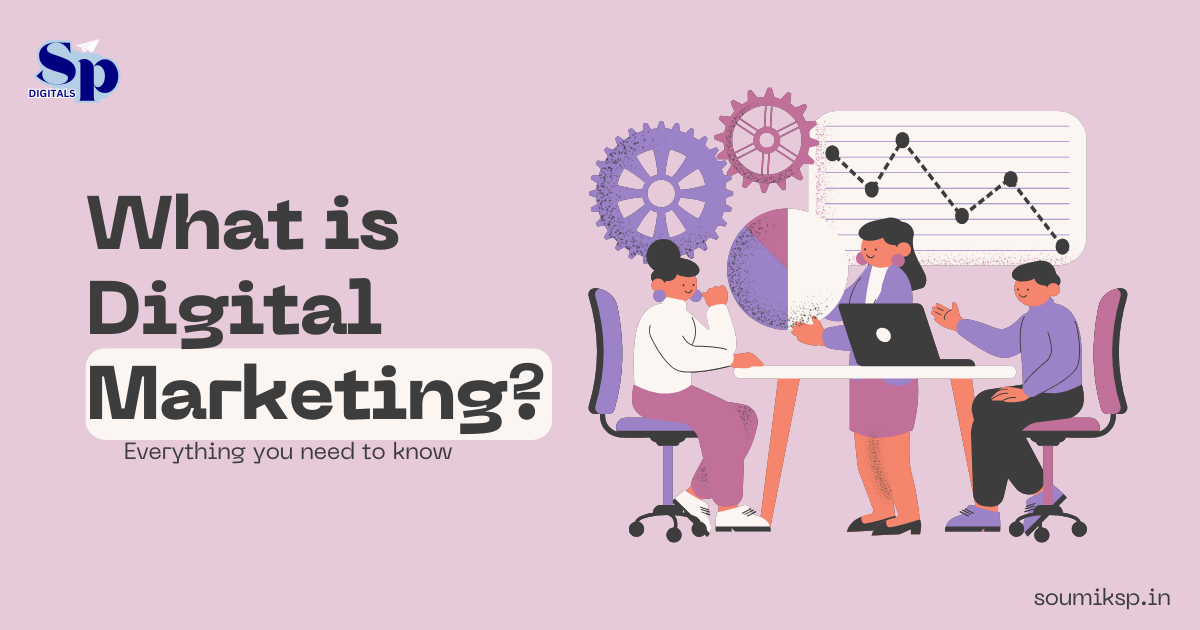
What Is Digital Marketing? The Basics Every Beginner Needs to Know
Every brand following you around with ads as you scroll, every blog post that shows up when you Google a question, every email hitting your inbox with a discount code — that’s all digital marketing in action. And if you’ve been wondering what digital marketing is, exactly, and whether it’s just a fancy word for “posting on social media,” the short answer is: it’s far bigger than that.
This guide covers the definition of digital marketing, how it works behind the scenes, why businesses invest heavily in it, how it compares to traditional marketing, and a breakdown of every major type — all explained in simple, beginner-friendly language.
What Is Digital Marketing? A Clear Definition for Beginners
Digital marketing, in simple words, is the use of digital channels to promote products or services, build brand awareness, and connect with potential customers. According to Adobe, digital marketing promotes brands and connects them to potential customers via the internet using channels that include search engines, websites, social media, email, mobile apps, text messaging, and web-based advertising.
The core idea isn’t new. Digital marketing uses the same fundamental principles as traditional offline marketing — understand your audience, craft a relevant message, and put it in front of the right people. What makes it different is where that message gets delivered and how precisely you can target it.
It’s also worth clearing up a common mix-up: digital marketing and online marketing are not the same thing. Online marketing — which covers SEO, email, social media, and pay-per-click advertising — is actually a subset of digital marketing. Digital marketing is the broader umbrella, including everything from digital TV ads and streaming audio to programmatic billboards.
The Four-Stage Process That Makes Digital Marketing Actually Work
Digital marketing isn’t just about creating content and hoping something sticks. It’s a structured, data-driven cycle. According to Google’s digital marketing resources, effective campaigns move through four core stages:
Stage 1: Strategic Planning and Audience Definition Every campaign starts with a goal — more website traffic, more leads, more purchases. Marketers then research their audience’s behaviours, preferences, and online habits to figure out where and how to reach them effectively.
Stage 2: Content Creation and Channel Activation. This is the execution stage. Marketers create blog posts, videos, social media content, ad copy, or email sequences and deploy them across the most relevant channels. A B2B software company might focus on LinkedIn and email. A fashion brand might prioritise Instagram Reels and influencer partnerships.
Stage 3: Performance Monitoring and Data Analysis. This is where digital marketing separates itself from a billboard. Using tools like Google Analytics, marketers track real-time data — click-through rates, conversions, bounce rates, cost per lead — to understand exactly what’s working and what’s burning budget.
Stage 4: Iteration and Optimisation. No campaign is ever truly finished. Marketers use performance data to refine targeting, test new formats, adjust messaging, and continuously improve results over time.
This continuous loop is what makes digital marketing so powerful. Real data, not gut feeling, informs every decision.
Why Digital Marketing Matters for Every Business Today
Here’s a stat that puts things in perspective: 68% of all online experiences begin with a search engine query, according to a BrightEdge research report. That means the moment a potential customer has a need, they’re heading online first. If your business isn’t showing up there, a competitor is.
Beyond just visibility, the case for digital marketing is concrete:
-
- Cost efficiency. Traditional channels like TV, radio, and print carry significantly higher production and placement costs. Organic digital channels — a blog, an Instagram account, an email list — cost mainly your time to build.
-
- Precise targeting. Digital platforms let you segment audiences by age, location, device, interests, and online behaviour. You’re not broadcasting to everyone and hoping someone relevant sees it.
-
- Measurable ROI. Every click, conversion, and lead is trackable. You know exactly which campaigns are generating returns and which aren’t.
-
- Two-way engagement. Unlike a newspaper ad, digital marketing lets customers respond, comment, share, and interact — turning a one-way broadcast into an ongoing conversation.
-
- Global reach with a small budget. A business can run a targeted campaign reaching customers across cities or countries for a fraction of what traditional media would cost.
Digital marketing also works across every stage of the buying journey — from the moment someone first discovers a brand, through the consideration and decision phases, right through to post-purchase retention.
Traditional Marketing vs. Digital Marketing: What’s the Real Difference?
The simplest way to frame it: traditional marketing talks at people; digital marketing talks with them.
| Factor | Traditional Marketing | Digital Marketing |
| Channels | TV, radio, print, billboards | Search, social media, email, apps |
| Cost | Generally high | Ranges from free to paid |
| Targeting | Broad, demographic-based | Precise, behaviour-based |
| Measurability | Difficult to track | Fully trackable with analytics |
| Communication | One-way | Two-way, interactive |
| Flexibility | Slow to change | Adjustable in real-time |
Traditional marketing still has a role — a full-page ad in a major publication or a TV spot during prime time can generate massive brand awareness instantly. But for most businesses, especially those with limited budgets, digital marketing delivers sharper targeting, faster feedback, and far better visibility into what’s actually working.
The other critical difference: digital marketing scales. A campaign that works for a ₹10,000 budget can be scaled up with the same strategic framework. Traditional campaigns often require building everything from scratch at each spend level.
The Main Types of Digital Marketing Every Beginner Should Know
Digital marketing isn’t one single activity — it’s a collection of channels and tactics, each serving a different purpose. Here are the most important ones:
- Search Engine Optimisation (SEO) is the practice of optimising your website so it appears organically at the top of search results. SEO covers three areas: on-page (content and keywords), off-page (backlinks from other sites), and technical (site speed, structure, mobile-friendliness).
- Search Engine Marketing (SEM) and Pay-Per-Click (PPC) paid ads appear at the top of search results. You pay only when someone clicks. Google Ads is the dominant platform, though Microsoft Ads, Meta Ads, and Amazon Ads are also widely used.
- Content Marketing: Creating genuinely useful content — blogs, guides, videos, infographics — to attract and educate your target audience rather than pitch to them directly. In 2022, 80% of marketers reported their content marketing strategy was extremely successful, according to Statista. The content marketing industry is projected to reach $107 billion by 2026.
- Social Media Marketing Building a brand presence and engaging audiences on platforms like Instagram, Facebook, LinkedIn, TikTok, and X. The goal isn’t just posting — it’s building a community that engages with and shares your content.
- Email Marketing Direct: personalised communication with subscribers through targeted campaigns. Newsletters, welcome sequences, post-purchase follow-ups, and promotional emails all fall under this category. It consistently delivers strong ROI relative to its cost.
- Influencer Marketing Partnering with content creators who already have the trust of your target audience. TikTok influencer campaigns see average engagement rates of nearly 16%, according to Statista, which explains why brands are allocating serious budgets to this channel.
- Affiliate Marketing: Recruiting external partners (affiliates) who promote your product in exchange for a commission on every sale or lead they generate.
- Video Marketing: Promoting your business through short-form or long-form video on YouTube, TikTok, Instagram Reels, or embedded on your website. YouTube in particular functions as a search engine, not just a social platform — making SEO principles directly applicable there too.
These channels don’t have to operate in isolation. The most effective strategies connect them — a blog post drives organic search traffic, a reader joins your email list, and a nurture sequence converts them into a customer.
Frequently Asked Questions
Q1. What is digital marketing in simple words?
⮚ Digital marketing is the practice of promoting your business through digital channels — search engines, social media, email, websites, and apps — to reach, engage, and convert potential customers online.
Q2. Is digital marketing the same as online marketing?
⮚ No. Online marketing is a subset of digital marketing. Digital marketing is the broader term that also includes digital TV, streaming audio ads, and digital billboards.
Q3. Can a small business benefit from digital marketing?
⮚ Absolutely. Digital marketing levels the playing field. A small local business can compete with far larger brands using smart SEO, consistent content, and a targeted social media strategy — without a massive budget.
Q5. What is the most important type of digital marketing for beginners to start with?
⮚ SEO and content marketing are strong starting points for long-term, sustainable growth. For faster results, paid search (PPC) can generate traffic almost immediately.
Q6. How do you measure success in digital marketing?
⮚Key metrics include website traffic, click-through rates, conversion rates, cost per lead, and return on ad spend. The right metrics depend on your specific campaign goals.
Q7. Is digital marketing a good career?
⮚ The data make a consistent case: demand is outpacing supply, the entry point is skills-based rather than credential-based, and the earning potential is real for those who build genuine expertise. It’s not an easy shortcut, and it’s more competitive than it looks from the outside. But for someone willing to invest in the right skills and document their work properly, the opportunity is there.
Q8.What Is SEO in Digital Marketing?
⮚SEO, or Search Engine Optimisation, is a set of methods used to help a website get more visitors and rank higher in search results. The higher a website appears on the search results page, the more likely people are to notice it and click it.
I really appreciated how this guide emphasizes that digital marketing goes far beyond just ‘posting on social media,’ highlighting the fundamental principles of understanding your audience first. Linking digital strategies to traditional marketing roots helps clarify why businesses invest so heavily in it, making it feel less like a tech trend and more like a necessary evolution. This perspective is exactly what beginners need to stop viewing it as just ‘ads’ and start seeing it as building meaningful connections.
This post made me realize how much digital marketing relies on the same core principles as traditional marketing. It’s interesting to see how these fundamentals adapt to online platforms, especially across so many different channels. It really helps clarify why businesses put so much focus on digital strategies today.